What makes a graduate program in classical education truly formative? Much like the rejection of utilitarianism in the K-12 classical education movement, the mark of an excellent program is not mere professional upskilling, but personal transformation. A truly remarkable graduate program leads students not only to become better educators but also to discover what it means to be more fully human.
Students of the University of Dallas Classical Education Graduate Program consistently describe their experience as rigorous and intellectually demanding, yet they also describe it as deeply nourishing of their souls and as firmly grounded in classroom realities. Those who enter the Great Conversation through this formation find meaning not only in the curriculum but also in a community of fellow students united in the pursuit of truth, beauty, and goodness. Among the richness of the program, five particular areas stand out as defining elements of the educational experience at the University of Dallas.

1. A Thoughtful Integration of Theory and Practice
The Classical Education Graduate Program at the University of Dallas does not isolate theoretical knowledge from practical classroom application. Instead, coursework consistently merges foundational ideas about education with concrete teaching practices. This structure allows students to lead their pupils to love truth and to encounter and fall in love with it in their own studies.
“Most professional development for classical teachers consists either of inspiring (but impractical) theory or modern pedagogical training, and this course bridged the gap between the two, giving the theoretical knowledge needed to properly evaluate common classroom practices.”
— Kathryn Ball
“I am grateful that the UD Classical Education Graduate Program combines theoretical and practical approaches to classical education, as my understanding of education and my teaching practices have significantly benefited from both theoretical and practical courses.”
— Teresa Roach
“The coursework is rigorous, but reasonable. The lectures have been of a very high quality–a good mix of theory and practice. And the scholarship makes it quite affordable. All three of these things make the program a very good fit for a working teacher trying to balance a work and school schedule.”
— Jeremy Brown
2. The Trivium and Quadrivium as Living Frameworks
Rather than treating the liberal arts as static or historical abstractions, students describe encountering the Trivium and Quadrivium as living structures that shape curriculum design, intellectual development, and classroom practice.
“In the spring, I studied the Quadrivium. With the trivium in the backdrop of my mind, I was thrilled and challenged as I dove into the circle propositions of Euclid’s Elements and then saw those play out in Ptolemy’s planetary theories. Through these pursuits, I encountered the beauty of the intelligibility of the world. I encountered the whole point of the Quadrivium. I can’t think of anything more inspiring for my new role as a math and science teacher.”
— Lauren Eller
“What struck me about studying the Quadrivium is that it wasn’t a frustrating struggle—it was merely a challenge to both my imaginative and reasoning abilities, and I experienced afresh what it means to grapple with a difficult concept through these faculties.”
— Julie Apel
“The Quadrivium course has introduced me to the classical manner of studying those disciplines which are today known as STEM. Prior to the course, I had an aversion towards and fear of mathematics, but this course has instilled in me a newfound interest in the mathematical arts and a confidence that I am capable of studying them.”
— Justine Sirilla
Request more information to learn more about the Classical Education Graduate Program.
3. Formation of the Whole Human Person
University of Dallas students consistently emphasize that the program not only shapes them into better teachers but also leads them to become more fully human. Coursework emphasizes personalism, moral formation, and the integration of intellect, will, and affectivity, forming educators who attend to the whole person.
“I see my pursuit of knowledge and skill in Classical Education as part of my journey to becoming fully human, fully alive to intellectual and spiritual significance. It is a work that is never finished.”
— Kylee Johnson
“Classical education is not about gaining something of utilitarian value, but about becoming more fully human. I have been able to encounter truth, beauty, and goodness in profound ways during my time within classical education.”
— Dominique Lefaive
“My studies have given me greater focus and clarity as to why I teach.”
— Cameron McGrady
4. A Joyful, Intellectual Community Marked by Wonder
Students take great joy in intellectually stimulating conversations with leading minds in classical education and in learning alongside faculty and fellow students alike. This environment cultivates an academic culture of wonder, inquiry, and genuine joy.
“My professors have demonstrated thorough and creative mastery of their subject areas, which has fostered a consistent atmosphere of joyful learning for me and my classmates. I normally have classes in the evenings after I have already taught for nine hours, but I seldom feel fatigued because I so look forward to the educational gold of our stimulating sessions.”
— Jonathan Duffey
“It is a privilege to have the opportunity to converse with classical teachers and administrators across the country. It is invaluable to hear their perspectives on curriculum choices, ways of challenging and encouraging students, and how we can all help the children in America’s classrooms to flourish in independent, joyful lives.”
— Megan Atherton
5. The Continuation of the Great Conversation
Students frequently describe their education as a continuation of the Great Conversation, one that reshapes how they read texts, frame questions, and engage students and colleagues both within and beyond the classical education movement.
“Classical education offers the student a glorious opportunity to receive the truth of the meaning of their life and invites the student into the great back and forth conversation that has been going on between the greatest minds for thousands of years. It is a culture that upholds the rule of law, seeks after truth no matter the cost, and promotes the common good.”
— Chelsea Niemiec
“Being deprived of many ancient texts during my grade school years, I now see the value of implementing these texts in the early years of K-12 education. In American education, it is especially important to read these texts, as our founding fathers drew on these texts for inspiration in founding our nation. To read ancient works is to connect oneself with a tradition reaching back to our Greco-Roman roots.”
— Cecilia (Aucoin) Leo
“Coursework in the graduate program has served as an invitation for me to join the long conversation that insists that education is an essential part of the human experience, one that gives purpose to us as individuals and communities, and one that nourishes our minds and our souls.”
— Kylee Johnson
Join Others in the Great Conversation at the University of Dallas
The University of Dallas Classical Education Graduate Program offers a formative education that equips classical educators to shape the next generation by drawing on the wisdom of the past and guiding students toward a deeper understanding of the true, the good, and the beautiful.
If you are seeking a graduate program that unites intellectual rigor, theory, practice, and virtue formation, the University of Dallas Classical Education Program offers a path worth exploring.
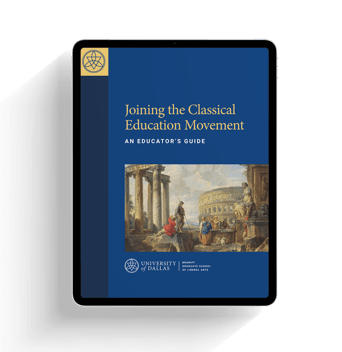
Download our eBook, An Educator's Guide to Joining the Classical Education Movement, to learn more.

Request more information to learn how the University of Dallas can support your vocation as a teacher, school leader, or lifelong student of classical education.